Scranton Senior Advisor
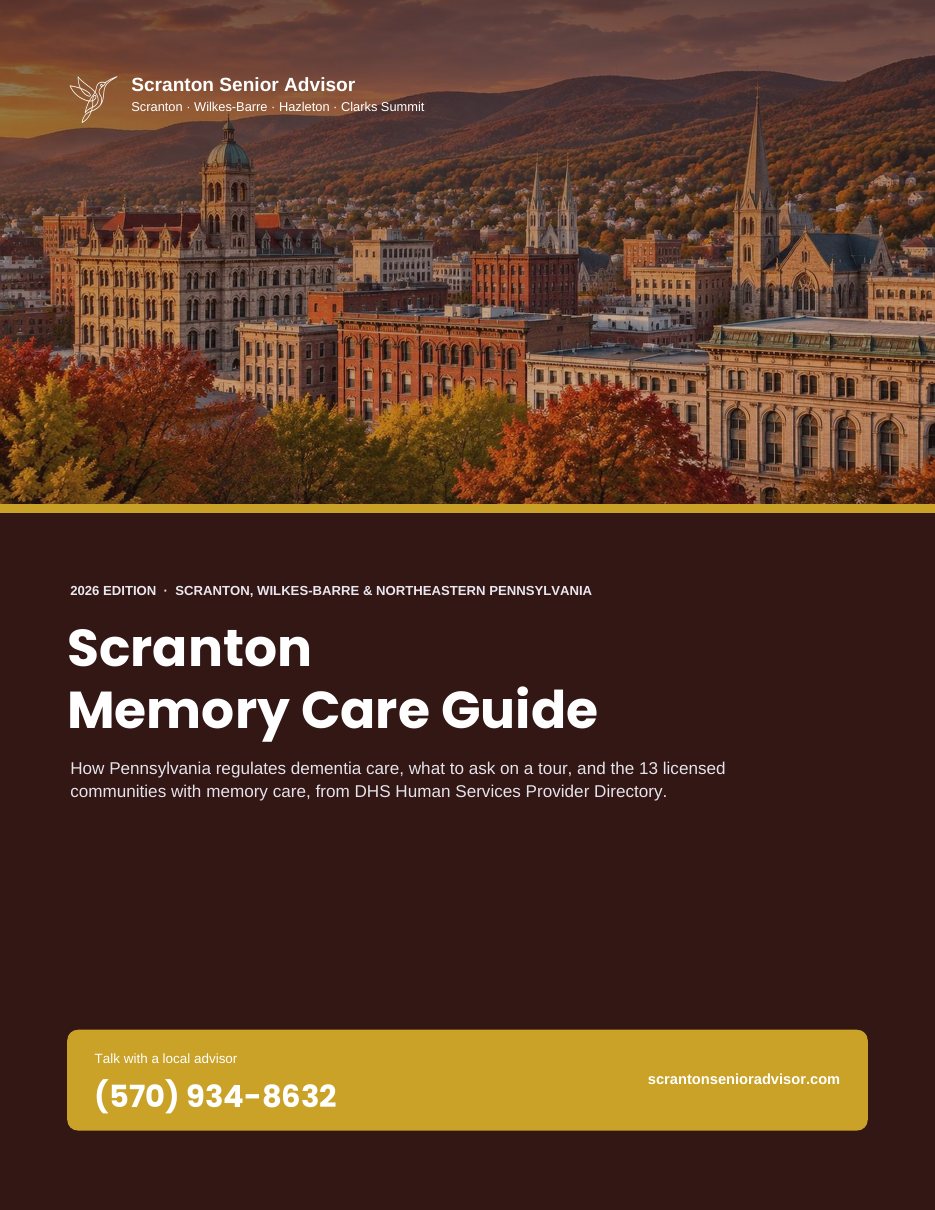
PDF, 6 pages, 2026 edition. Data as of November 15, 2026.
What is in the Scranton Memory Care Guide?
The guide walks through five things:
- How memory care differs from regular assisted living, side by side.
- What Pennsylvania requires of a community that serves residents with dementia, with the rule citations.
- 13 licensed communities in Lackawanna and Luzerne counties identified as offering memory care, with 372 secured beds.
- How memory care pricing compares with the Pennsylvania assisted living median.
- A touring checklist built for dementia care, including what to watch for at the end of the day.
How is memory care different from assisted living in Pennsylvania?
The difference is the setting and the staff: Pennsylvania memory care adds a secured area and dementia-trained caregivers to ordinary assisted living.
| Assisted living | Memory care | |
|---|---|---|
| Need | Daily help, mostly independent | Memory loss that makes living alone unsafe |
| Environment | Apartment-style, unrestricted | A secured wing or small house |
| Day | Self-directed | Planned activities with cueing |
| Bill | Base plus care level | Typically the higher of the two |
How does Pennsylvania regulate memory care?
Pennsylvania licenses dementia care as a locked unit inside a personal care home (a secured dementia care unit) or an assisted living residence (a special care unit). Around Scranton and Wilkes-Barre only homes with that unit on their certificate may lock residents in, and the rules add an admission screening and extra yearly training.
- License. The unit and its capacity appear on the home's Certificate of Compliance (55 Pa. Code 2600.231 and 2800.231).
- Admission. A medical evaluation within 60 days documenting dementia and the need for a secured unit, plus a written cognitive preadmission screening.
- Training. Six hours of dementia-specific training a year for unit staff, beyond the twelve hours every direct care worker completes.
- Review. The resident's assessment and support plan are reviewed at least every three months.
How many Lackawanna and Luzerne counties communities offer memory care?
Homes with a secured dementia care unit or special care unit and its capacity on the DHS certificate, 13 licensed communities in Lackawanna and Luzerne counties offer memory care, with 372 secured beds between them.
The largest clusters are in Clarks Summit (2), Drums (2), Moosic (2) and Peckville (2). 0 of them are small settings licensed for 20 residents or fewer.
What does memory care cost in Pennsylvania?
No published memory care median exists for Pennsylvania because CareScout does not survey it. Unit rates in the two counties usually sit above the $6,480 state assisted living median; ask each home for the unit rate and any care-level fees in writing.
How do I judge a memory care community in Scranton on a tour?
Go at the end of the day, when the unit is at its busiest, and bring these questions:
- Can we visit at mealtime without notice?
- What happens if a resident wanders out?
- What did your last state inspection find?
- What dementia training do caregivers receive, and how often is it refreshed?
- Can residents keep their own doctor?
Who helps a Lackawanna or Luzerne family when a dementia unit placement goes wrong?
The long-term care ombudsman, reached through either county's Area Agency on Aging or the state office at 717-783-8975, advocates for residents at no charge and can join a care meeting with the resident's agreement. Licensing complaints go to DHS at 1-877-401-8835, and suspected abuse to 1-800-490-8505 at any hour. The Alzheimer's Association helpline, 1-800-272-3900, answers caregivers around the clock.
Want a shortlist instead of a long read?
Describe the diagnosis stage and the behaviors that worry you, and we will suggest settings that fit.
(570) 934-8632More free downloads
Who publishes this guide, and how is it paid for?
Scranton Senior Advisor writes and pays for it. We are a local placement and referral service, so our income is a referral fee from the provider a family chooses, never a charge to the family.
No listing is paid for: every name comes from the Pennsylvania Department of Human Services (DHS) record. Treat the guide as general information, and confirm a license with the state before you sign anything.